On August 11, 2008 we gave birth to a beautiful baby boy, Christopher Harry! Christopher was one of the first babies in GA to be picked up on the newborn screening with a rare inherited Fatty Oxidation Disorder called LCHADD (Long Chain 3-Hydroxyacyl-CoA Dehydrogenase Deficiency). As Ryan and I (Stephanie) gained more understanding about our son's condition and began to watch him grow and thrive, we had a desire to share our story and raise money for research. We hope that by sharing our story we can raise awareness/encourage education about LCHADD and provide hope to other families whose child(ren) have this condition.


This blog shares our journey, hopes, and fears. We also want this blog to contain practical information! Entries will include: yummy recipes, how we manage his LCHADD, conversations about medical issues, educational tools, and useful links on the side of the blog! If you are ever curious about something I have shared feel free to contact me personally!

What is an FOD?

WHAT IS AN FOD?


FOD stands for Fatty Oxidation Disorder. For children and adults with FODs their bodies have difficulty breaking down (or oxidizing) fat to use it for energy. This occurs when an enzyme is missing or not working properly. There are several different kinds of FODs. Some examples are SCAD, MCAD, VLCAD and LCHAD deficiency. Fatty Oxidation Disorders are genetic, which means both parents must have the recessive gene in order for their child to end up with the disorder. It also means that children with FODs will not grow out of their condition. Their condition is just as much a part of who they are as the color of their eyes or hair.

What is LCHADD?

WHAT IS LCHADD?


LCHADD stands for Long Chain 3-Hydroxyacyl-CoA Dehydrogenase Deficiency. Essentially children with this condition cannot utilize long-chain fats for energy. Did you know that the food that we eat has different size fat molecules in it? I never did until Christopher was born! There are short-chain fats, medium-chain fats, long-chain fats and very-long chain fats. I picture them as different size caterpillars (and this is how I explain it to Christopher) running around in our food. The short, medium, and very-long chain fats children with LCHAD can process. Unfortunately, most of our food and oils are primarily long-chain fats (the ones Christopher can’t process). If Christopher eats too much fat (right now he can only have 8-9grms of fat a day through food) then the fat will gather in his liver, kidneys and around his heart.


The other issue with Christopher not being able to breakdown long-chain fat is that it is a great energy source. For most of us, when we exercise or get sick and we burn through all of our glucose stores we start using fat for energy. Christopher’s body cannot do this, so his body starts to break down muscle and use it for energy instead. To say that this is “not good” is to speak lightly. When your body starts breaking down muscle you run the risk of having problems with lots of different systems in your body. Doctors worry the most about your kidneys because kidney failure can happen when your body is trying to process all of the broken down muscle (or myoglobin which is the by-product of the broken-down muscle).


In general, children with LCHADD are put on a very low-fat diet, drink a special medical formula, and most often use MCT oil (a unique oil comprised of medium chain fats) to give them a source of sustaining energy. Christopher's special medical formula, Lipistart, helps to ensure that he gets enough essential fat for brain and eye development without getting too much fat that his body can’t process. Lipistart also helps to provide a consistent form of energy for him throughout the day.


Tuesday, November 6, 2018

What Makes a Good Hospital Stay!!


     On the one hand, you know you have visited the hospital a little too often when you can write a blog comparing your different stays…hoping to learn from your previous experiences to make your next stay better.  On the other hand, I recognize that compared to some kids with Fatty Acid Oxidation Disorders, Christopher’s hospitalizations have been relatively few!  I am extremely grateful for the countless times Christopher has been able to fight illness without a hospitalization!  And yet, just three weeks ago we found ourselves unexpectedly at the hospital once more.  As we left, I had to ask myself, “What made this visit feel so much easier?”
   First, the clinicians listened!  Even if you have never experienced a hospital stay, I am sure you can imagine how challenging it is when you have doctors on your team that are not hearing you out.  I try to keep in mind, during our hospital stays, that doctors are human and that I have no clue what went on in their day…but let’s be honest, when Christopher is having muscle breakdown (rhabdomyolysis) my guard is up and I am ready to fight for whatever he needs to make him better.  A common tension amongst families of children or adults with a rare chronic condition is that families often know more about the condition than the doctor.  This is by no means an insult to all of the schooling doctors go through!!  How could I expect a doctor to stay up to date on the latest LCHADD information when there are only 6-8 kids in the entire state of Georgia with it!  I feel like the doctors and I do a dance when we first meet, when Christopher is admitted to the hospital.  They are trying to see what I know, and I am trying to see if they are willing to listen. 
     The fifth floor doctors at Eagleton Children’s Hospital this visit were amazing!  They treated me like I was a team member.  They ASKED Christopher and I questions, AND LISTENED!  They were even honest that they had never met a child with LCHADD.  All of this created wonderful patient/doctor report!  Plus there were the little things that showed they cared:  They requested a “My Special Body” book and wanted Christopher to sign it!  The nurse figured out how to get Christopher hard-boiled eggs by creating a “medical order” with the cafeteria.  The doctors not only followed my son’s protocol letter but also helped coordinate care by reaching out to his pediatrician!  All of these actions helped calm my anxiety about Christopher’s care, and allowed me to focus on just being my son’s mom during this stay.
    Second, the stay felt easier because I packed a lot of Christopher’s own food!  It may sound crazy, but after Christopher had dark urine (a sign of muscle breakdown) and I spoke with his doctors about bringing him in, the first thing I did was start packing food I knew he could eat.  One of the hardest challenges with past hospitalizations was that we were so limited with what Christopher could order from the cafeteria.  After Christopher has rhabdomyolysis, it is really important that he is eating well and getting high protein/complex-carbohydrate meals that are still low in fat.  With this in mind I packed: greek yogurt, low-fat ham, Ezekiel bread, tortillas (I had just made), beans and rice, and fresh fruit.  This fore-thought gave us so much more wiggle room with the timing of my phone calls down to the cafeteria and took away the stress of not knowing if I would have what Christopher needed nutritionally, when he needed it! Ultimately, we used the hospital meals to supplement what we couldn’t pack from home.  When I showed up in the ER with a large cooler I got a lot of curious looks, but it was worth it!
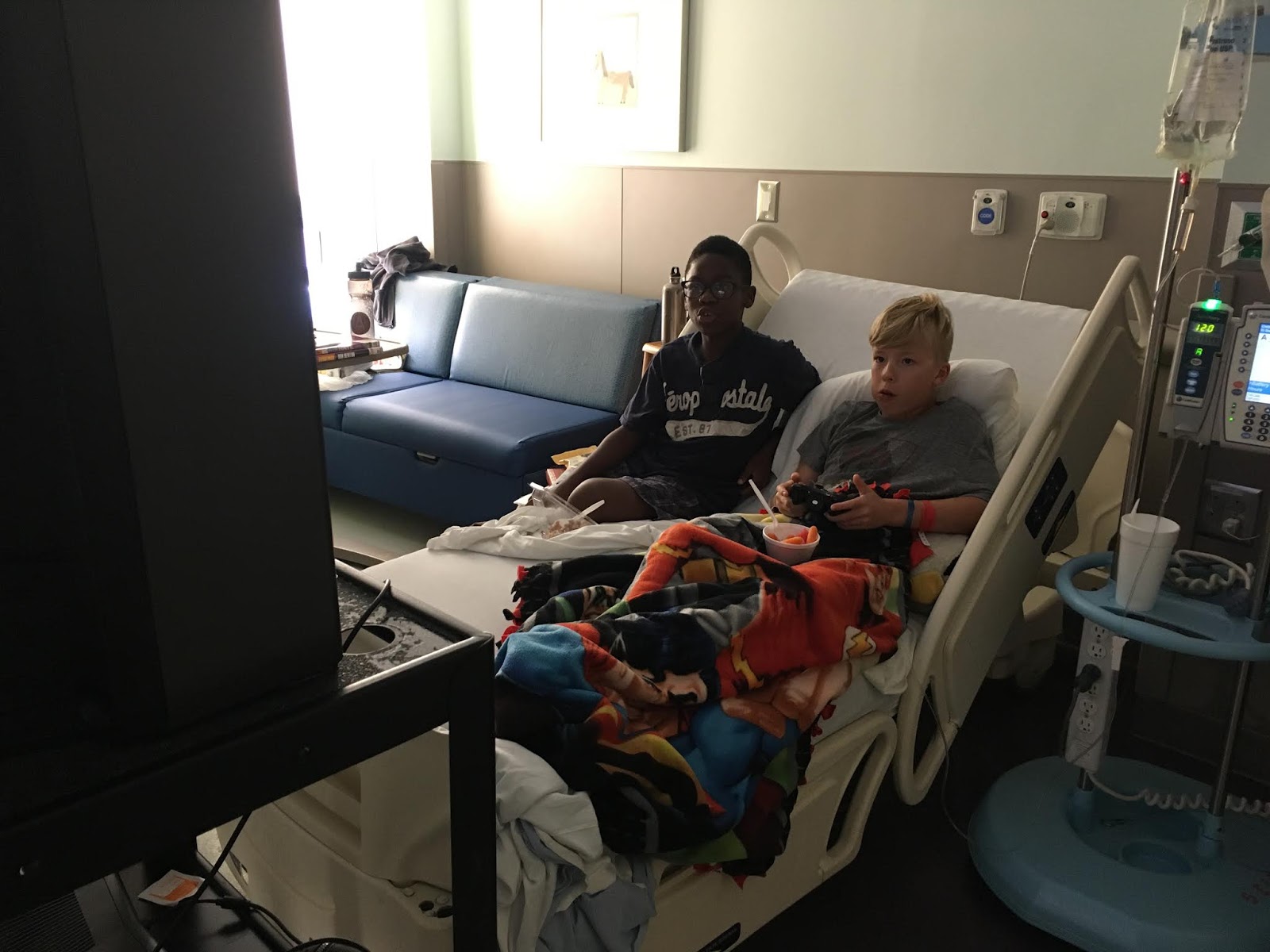
Playing x-box with his buddy Ireon!
     Christopher’s outlook was a bit different than mine, but in true kid fashion.  First, he loved that he “got to rest” because “my legs were so tired”.  He thought it was really cool that he got to enjoy “x-box” and visit the hospital’s library.  We watched movies together, a soccer game, read…and he even had a couple visitors! Wheeling him around the courtyard or playing piano in the chapel broke up the day tremendously.  
Hospital stays are not all the same.  They are a lot harder when he is having muscle breakdown due to a viral infection.  Not only is it scarier (cause you never know when those cks will peak and what other damage may occur), but he has to be confined to his room so as to protect other patients.  Anyone confined to one room for 3-5 days is bound to go stir crazy! 
   For those of you new to the LCHADD world I know you are wondering why these kids end up in the hospital so much, or perhaps you are wondering how Christopher landed in the hospital this go around.  For kids with fatty acid oxidation disorders (like LCHADD), when they get sick and are fighting viral infections their body cannot use their fat as energy.  So if they go through all of their sugar stores, their body will try to use the fat for energy but when it can’t it will start to break down the muscle instead.  This muscle breakdown leads to toxic by-products in their blood, such as myoglobin.  These toxic by-products are really hard on your kidneys and liver.  The treatment is to increase their calorie intake and start over-hydrating to try to flush the toxic by-products in their blood stream. This is done through oral hydration, IV, N-G tube, and/or G-tube depending on the situation.  Depending on how much muscle breakdown Christopher has experienced, and the cause, sometimes we can treat him from home.  Unfortunately, the only way to know exactly how much muscle breakdown he is experiencing is by getting a blood draw.
    Muscle break down can occur for these kids for a couple different reasons.  Sometimes it occurs if they get a viral illness with fever, and are unable to eat.  Other times they might play really hard at a sporting event/recess and not consume enough calories or maintain hydration as well as they thought.  Other moments there is what we consider the “perfect storm” of events.  Perhaps, it was a super amazing day!  Your child eat as he/she normally would have but unbeknownst to anyone they used more energy at the playground, and then they were hitting a growth spurt, and they were excited for the birthday party after school.  All of these things effect your metabolism and calories needs, but it is super hard to know when your child is hitting another growth spurt or how to compensate for excitement or stress.  All these things together can lead to muscle breakdown.  Then there are times when kids go into rhabdomyolysis and there is nothing as a parent you can pin-point.  Those are the hardest moments. 
Christopher back at school with his friends!
   This last episode for Christopher, we were never able to pinpoint one particular event that led to his muscle breakdown.  The resident doctor kept talking about Christopher’s “fantastic” day!  I loved the way he put this, because there was no blame or judgment in his tone for this episode.  He helped Christopher embrace the beauty of his day with the unexpected consequences.  Yes, Christopher had a busy day on October 6, 2018!  He got to spend all day with dad at school in his gym, played a short game of soccer with his friends in the afternoon, enjoyed a Nerf battle with his buddies during a sleepover and was looking forward to his best friend’s birthday party the next day!  He stayed “fueled” up very well through all of this!  Was this a lot?  Yes.  Has he had “fantastic” days before and not had muscle breakdown? Yes.  What sent him over the edge?  Growth spurt?  Stress?  Excitement?  The doctors told me I will drive myself crazy if I try to figure out why in this scenario.  And so, I have chosen this time to let the “why” go, throw the reasoning out the window, embrace his “fantastical day,” and feel grateful for a peaceful hospital stay.


Tuesday, August 28, 2018

"It's Cool to Have LCHADD..."


            This summer the Harry Crew took a road trip from Atlanta, GA to Minneapolis Minnesota and then on-ward to Lake Superior!  It was our first big road trip together that wasn’t to visit family and we stopped at several state parks along the way, and saw beautiful landscapes, boulders, and water.  After all of our adventures, what does Christopher talk about the most?  Where does he keep bugging me to go back?  “Mom, when can we go back to the Embassy Suites Hotel?”
            Yeah, sure, there was a pool, he got to watch soccer on a big screen, and he even got to eat something more than fruit at the continental breakfast (which is rarely the case).  But the zinger was that the FOD Family Support Group conference was there and for the first time, that he can remember, Christopher was able to connect with kids his age and older with FODs.

Learning how to make fat molecules and how they work in the body!

   This year at the conference, while the adults were learning about the latest research, and seeking to support each other through stories, their children were given the opportunity to do the same thing…in their own way.  We had two sessions for youth.

Learning about fat, protein and carbohydrates!

The first day we learned about our body: how it functions, how it metabolizes the food we eat, and how cells break down fat for energy in the mitochondria.  Our second day we did a science experiment discussing rhabdomyolysis (muscle breakdown) and then nine kids partnered up to role-play asking questions of doctors; confidently!
What touched my heart more than anything was watching Christopher connect for the first time with Luke, an older youth with LCHADD.  I’m not sure that they had super deep conversations about living with LCHADD (although perhaps I shouldn’t put anything past my 10 year old son), but Christopher enjoyed getting to spend time with him so much!  A space was created…a kind of space he hasn’t had before…where LCHADD existed outside of himself and his experience…and perhaps for a moment having LCHADD, counting fat, taking MCT oil, monitoring exercise; was a norm.  Christopher came back after playing cards with Luke Saturday afternoon and said, “It’s cool to have LCHADD!”  The door was open for him not to feel alone in this journey, and I still tear up thinking about it.
Luke took time to hang with Christopher during one of the adult sessions!
The conference plays an important role for every family who has a child with an FOD.  It creates space for clinicians to disperse new information, while inviting families to ask questions and seek understanding.  There is a tremendous feeling of support as you share your stories and listen to others.  These stories are also helpful for the clinicians to hear because when you deal with rare inherited conditions sometimes overlap of symptoms are noticed for the first time in environments like these. 
Thank you to Deb Gould and all of the volunteers that help organize this conference! And thank you to the clinicians and families that take the time to come!  Conferences like these are extremely expensive to put on!  Ryan and I are running a Half Marathon on November 10th at Chickamauga Battlefield in North GA to raise awareness about FODs and money for our next conference.  Please consider donating!!!  There are two ways to give.  You can either donate on-line: https://fodsupport.networkforgood.com/projects/44599-fod-fundraising-2018 (select amount, then “Chickamauga Battlefield”) or you can donate via check: Payable to: “FOD” and put in memo “Race donation/General Trust.  All checks should be mailed to: Deb Gould, PO Box 54, Okemos, MI 48805-0054 .  All donations are tax deductible!


Tuesday, January 23, 2018

Will He Get Tired of Cooking?

      “Will he get tired of cooking…tired of eating…as he gets older?  How will this affect him?  Will this lead to him being off diet?”   This thought, or worry, goes through my head on occasion.  Typically it is after a long day when I myself am exhausted and the last thing I want to do is cook.  On those days I think about Christopher.  What will it be like for him when he is 20 and comes back from a long day of classes and doesn’t feel like getting something to eat?  How will we teach him to push through in those moments and do the right thing?  How do you prevent burnout from cooking?
            I have brought Christopher into the kitchen with me from a very young age, trying to encourage a love of food and “the process” that is cooking.  He used to love being in the kitchen flipping pancakes with me, but on an average night, after a long day of school he is much more interested in playing; which I totally understand!  Yet, I still try and create these moments, where I can teach him skills.  And for the now, this is enough.
            I am fully aware though, of how much time food prep takes for my little guy.  I easily spend three hours a day cooking and preparing food…And that doesn’t include dishes (thanks Ryan!).  So how will he carve out that time into his own schedule as he gets older?  How do I support him as a young adult?
Trying to make food fun for football game!
I am hoping to glean tips along the way from older parents, and the FOD Conferences.  One mom shared that she makes a couple of meals that her son can freeze and take with him to college.  Another mom and her daughter worked hard with the college cafeteria to make sure there was always food available for her.  I tuck these ideas in the back of my brain.  But what else?

Tuesday, November 28, 2017

It's Waffle Time!

  There are these moments, as your kids get older, that feel so surreal.  I appreciate these moments because I am able to stop, quiet my mind, truly enjoy the moment, and bask in what that moment “is”.  I find myself overcome with gratitude  when I watch Christopher take initiative with practicing his piano, when he still begs for a story time, or when he asks to do something new…and it clicks, “Wow, he is old enough to try this!”


  A couple of weeks ago, Christopher asked to make waffles by himself.  This may not seem like a big deal, but all store bought waffles have too much fat for him.  So when we make waffles, we do it from scratch.  I hesitated, then realize that we were really here.  We were really at a place where he could explore doing this and I could sit and read a book close-by in case he had questions, or I noticed something unsafe (like the waffle iron popping out of our old 1970’s waffle maker).
  He did such an amazing job!  And I will never forget this moment.  Here is the recipe that we use to make waffles.  They aren’t quite as crunchy as I’d like them, so sometimes I will put them in the toaster after we take them out of the waffle iron.  I was told that homemade waffles just aren’t crunchy the first go around…but I suppose it could be my iron too.


Buttermilk Waffles

Ingredients:
·      1 cup unbleached all purpose flour
·      1 cup whole-wheat flour
·      1 tbls brown sugar
·      1/2 tsp salt
·      1tsp baking soda
·      1/2 tsp ground cinnamon
·      1/4 tsp salt
·      2 cups non-buttermilk
·      2 eggs, separated (One egg yolk you will keep, another you will discard.)
·      2 tsp MCT oil
·      2 tbls Banana
·      2 tbls non-fat greek or plain yogurt
·      1/4 tsp vanilla extract
·      1/4 tsp almond extract
·      Non-stick spray for grill

Directions:
1.     Turn waffle iron on to pre-heat.
2.    Make non-fat buttermilk by juicing 1 lemon into a 2 cup Pyrex measuring cup.  Add enough non-fat milk to make 2 cups.  Set aside for 5minutes and your milk will turn into non-fat buttermilk.
3.    In a large mixing bowl mix flour, brown sugar, baking soda, cinnamon, and salt.
4.    In preparation for the eggs get a small bowl and medium size bowl and place on counter.  Crack first egg and put egg white in medium bowl and egg yolk in small bowl.  Crack second egg and put egg white in medium bowl and throw the remaining yolk in the trashcan.
5.    In small bowl with the egg yolk mix MCT oil, banana, yogurt, and extract until fully combined.  Set aside.
6.    With electric mixer beat egg whites until stiff peeks form. Set aside.
7.    Mix non-fat buttermilk into dry ingredients with a wooden spoon, quickly, until almost blended
8.    Add small bowl of wet ingredients, until combined.
9.    Gently fold in egg whites.
10.  Spray top and bottom of waffle iron with non-stick spray.  Then spoon out batter in the middle of the iron until it ALMOST covers the edges. (If you go all of the way to the edges the batter will spill over the waffle iron and it will be a mess!)
11.   Close waffle iron and wait approximately 2-3 minutes for waffle to cook before you remove


*7 grams of fat for the entire recipe.  Makes approximately 17 waffles.  Each waffle contains about 0.3 grams of fat.

Monday, March 13, 2017

"...Not Because (it is) Easy..."


       Over the last two years I’ve been deeply encouraged by figures of history who have done tremendous things, despite illness.  When I was a child we learned about heroic figures such as Abraham Lincoln or John F. Kennedy, but somehow their ailments and struggles were omitted from what we learned.  Perhaps historians felt these facts would somehow make them weaker figures.  Yet, I have found that knowing these figures’ struggles and hardships have left me with an even greater awe and admiration for these people I have never met.  In fact their personal struggles, I believe, make these figures’ stories more beautiful.
       It all started last year when Christopher got a cold and was out of school for a couple of days.  His class was learning about Theodore Roosevelt.  I got several books from the local library and was fascinated to learn that he
Christopher as JFK next to his project for school.
was sickly as a child, and often struggled to breath.  As we read about Theodore and then Franklin (who had polio) I was very intentional about trying to connect how these leaders were able to accomplish great things in the midst of pain, hardship, and illness.  I definitely got the “Yeah, yeah…” response, any seven year old little boy might give.  Yet, it challenged me, as I started to recall other biographies I had read, where people overcame not just personal hardship but physical ailments to accomplish important things.  Abraham Lincoln struggled with depression, Helen Keller was blind and deaf, and John F. Kennedy had such severe back pain that he had meetings with close advisors while soaking in his bathtub! 
We were so proud of the hard work he put into this project!
A little over a week ago Christopher participated in history day at his school.  He spent about three weeks researching John F. Kennedy in preparation for the speech and project he created.  It’s embarrassing to admit, but all I knew about JFK before this project was that he was Catholic and was assassinated.  It was eye opening to learn more about his journey, especially his illnesses and personal tragedies.  Christopher and I discovered together that this historical figure was very sick as a child, dealt with severe chronic back pain, was diagnosed with Addison’s disease, and had two siblings die as young adults.  Kennedy refused to let these challenges prevent him from accomplishing his goals, and Christopher seemed to connect this more to his own life this time.  Again I was inspired and hopeful.
One of the many notes he took for his project.
            John F. Kennedy said, “We choose to go to the moon… and do the other things, not because they are easy, but because they are hard.”  When Christopher was in my belly, I often prayed that he would be a “fighter.”  That this child I had would know the importance of not giving up, no matter what.  LCHADD can make certain tasks feel harder at times, but this doesn’t have to be the end of Christopher’s story.  The longer I live, the more I believe that the power to change things for the good is born out of struggle.   My hope is that Christopher will use his struggles to create beautiful and powerful changes in this world.


*In loving memory of Grandma O, who adored JFK and my sister, Veronica, who taught me about courage and pain.

Monday, March 6, 2017

Life is Filled With Seasons!


               As I sit in front of my screen trying to process the last month and half, I keep coming back to a conversation that I had with Dr. McGuire at NIH, awhile back.  He said something like, “A person’s metabolism is always changing…and this will affect Christopher.  What he might be able to do one year he might not be able to do the next, and he/you will have to be okay with that.  He might be able to handle baseball just fine this year, but perhaps can’t do it in first grade…but does fine with it in third.” I appreciated this word of wisdom, and tucked it away in a suitcase in my brain labeled, “Things to remember”, to be taken out at a more appropriate date.
Beating mom at Rummi!
            The appropriate time was February, but it hit like a ton of bricks.  January 2, 2017 Christopher came back from our Christmas trip to Maryland and Pennsylvania and was really exhausted.  He was suppose to return to school that week, but his body was just feeling too tired so we rested.  By the end of the week he had come down with a cold.  This cold metamorphosed into pink eye, and then 4 days later into a sinus infection, which led to antibiotics.  Christopher tends to get secondary infections with colds, but this time his body was so much more tired. Then one evening after being on antibiotic for about a week, he woke up at 4am complaining that his whole body felt weak and it was hard to sit up. 
            I gave him Lipistart and honey, then watched him as he fell back asleep.  Was he breathing okay?  Had this turned into pneumonia?  Was his heart okay?  Could he have developed cardiomyoapthy?  This new word, “weak,” scared me.  It was something that I have read other LCHADDers describe.  It was something other parents talked about at support conferences, but until then Christopher had never verbalized this feeling.  I was scared.  What if I missed something?
            That day led to a plethora of observation, phone calls, questions and blood work.  Christopher’s cks came back normal, the doctor said his heart sounded fine, and yet here we were.  Christopher wasn’t feeling well, and was not his normal vibrant self.  He went through several days where I had to assist him to his bedroom or the bathroom because he felt too weak to do it himself.  Our metabolic team, and another metabolic doctor in PA both confirmed that he was still within normal range for an “LCHADD” recovery after illness.  This provided some comfort, but Christopher had missed over 20 days of school since Christmas…it was the longest he missed consecutively since he started school.  So it didn’t feel like his normal.  His pediatrician agreed with me but what could we do other than wait?
            That is what we did; wait.  For about six weeks we took it easy did low key activities and homeschooled.  As much as we could, we did half days at school.  I knew we were headed into unchartered territory with our experience of LCHADD, so I reached out to friends.  I took comfort in older LCHADD parents who shared their wisdom and experience.
When he went back for half days he had fun staying inside with a couple of buddies for low-key recess!
            Then one day he went a full day of school.  Then the next day he felt like he could play catch with a baseball.  Then his best friend came over and they ran around the house and he didn’t crash the next day.  Why?  Why did recovery take so long this time?!  I think the hardest part is that there is no way to know.  It would be nice if LCHADD was like a mathematical equation where 2+2 always equals 4.  The fact is that with a cold: Proper hydration + Proper nutrition = most often recovery…but not always, and not always as quickly as one might predict.  LCHADD just gives way to a certain level of unpredictability that, eight years in, I still struggle to wrap my mind around.
A moment I remembered how blessed I am.
            But guess what?!  Amidst all the uncertainty and the length of time of this last recovery; Christopher is doing well now!  And I am reminded that life is filled with seasons.  A sick season may prove hard and at times scary, but I hope I will always remember the beauty that is born from this season too!  First, there are the extra long story times we have, with books I never knew existed, or new board games to learn to play!  Then there are moments of puzzle fun, legos, and this January many episodes of "The Andy Griffth Show."   Scholastically, I have a better understanding as to what they are learning at school.  He gets one-on-one “mommy tutorial” (for better or worse) and is challenged to know about subjects they might not cover as a second grader (this last episode he did a research project on dynamite and we studied the body/circulation).  And so as hard as these periods of illness may be, I know and trust that these moments we have together will produce something special in him.


Sunday, December 4, 2016

Christmas Cookie Reciepe!

     I do love Christmas time.  I love the music, the lights and staring at our Christmas tree...but I also love the smells!  The cinnamon, the cloves pushed into the orange, and the cookies!  Last year I promised Kristy that I would get this recipe posted, and I am so sorry that I didn't!  But alas, here it is, our Sugar Cookie Recipe.  I can't take credit though, it was my grandma's recipe that I exchanged the butter out for MCT butter...and it just so happened to work perfectly!  The MCT Butter recipe came from a dear LCHADD parent in Canada, so it was a group effort!
     I will start with the MCT Butter recipe because you will need to make this first and follow up with the sugar cookie recipe.  Enjoy!


MCT Butter

Ingredients:
·      1 tablespoon corn starch
·      3/4 cup skim milk powder
·      1 tablespoon lemon juice
·      3/4 cup water
·      1 cup MCT oil

Directions:
1.     Mix lemon juice, water and oil into a pyrex cup.
2.    Sift dry ingredients into a small sauce pan.
3.    Turn stove on medium heat.
4.    Slowly pour in liquid while mixing with a whisk.  (Alternate with a spoon if dry ingredients get caught in crevices of pan.)
5.    Continue to mix over medium heat until butter thickens and is smooth.
6.    Keeps in fridge approximately 2 weeks.

Tips:
* This recipe makes 2 cups of butter, so 2 cups of butter has 1 cup of MCT oil.
* DO NOT USE THIS RECIPE IF YOUR CHILD HAS MCADD or cannot process medium chain fats!
 

Grandma’s MCT Sugar Cookies

 Ingredients:
·      1/2 cup MCT Butter
·      1 tsp. salt
·      1 tsp. vanilla
·      3/4 cup sugar
·      3 egg whites
·      2 1/2 cups all purpose flour

Directions:
1.     Make MCT Butter using the attached MCT butter recipe.
2.    Combine MCT Butter, salt, vanilla, and sugar in a large mixing bowl.
3.    Beat three egg whites in a small bowl, by hand, until slightly frothy.
4.    Pour egg whites into large mixing bowl and stir to combine.
5.     Sift flour and mix well.
6.    Chill thoroughly in the refrigerator.  (This will take at least 2 hours!)
7.    After dough is chilled, pre-heat oven to 350°F.
8.    Line two cookie sheets with parchment paper.
9.    Flour counter top and rolling pin.
   10.  Take approximately 1/3 dough, lightly flour both sides and roll out flat with rolling pin until 1/4 or 1/8 inch thick.  Use cookie cutters to cut desired shapes.  Place cookies onto parchment lined cookie sheets. Re-shape dough, flour and roll until all dough is used. 
11.   Decorate cookies with sprinkles or crushed peppermint.  
12.  Bake at 350°F for 8-10 minutes.

Tips:
*When buying sprinkles be aware that different brands have different amounts of fat!  Some sprinkles are just colored sugar and have no fat!  Yet, the traditional “sprinkles” greatly vary on brand, so look close to see what best fits your child’s needs.
*This recipe is meant for any child who needs to supplement their diet with MCT oil, but should be safe for family members without FODs.  My husband and I enjoy a cookie with our son without a tummy ache from MCT oil!  DO NOT USE THIS RECIEPE IF YOUR CHILD HAS MCADD or cannot process medium chain fats!

*If dough is sticking to your rolling pin or counter top then you need to add more flour!  Sprinkle a little flour on the countertop so it is almost invisible, but still feels rough to the touch.  Sprinkle some flour on the dough and on the pin.  As you roll out your dough, flip the dough over every other roll, flouring the top of the dough each time so it doesn’t stick to the countertop when you flip.